
Navigating Sustainability: Challenges and Strategies with the Help of the ALG Centre
10/19/20258 min read
Introduction to Sustainability Challenges
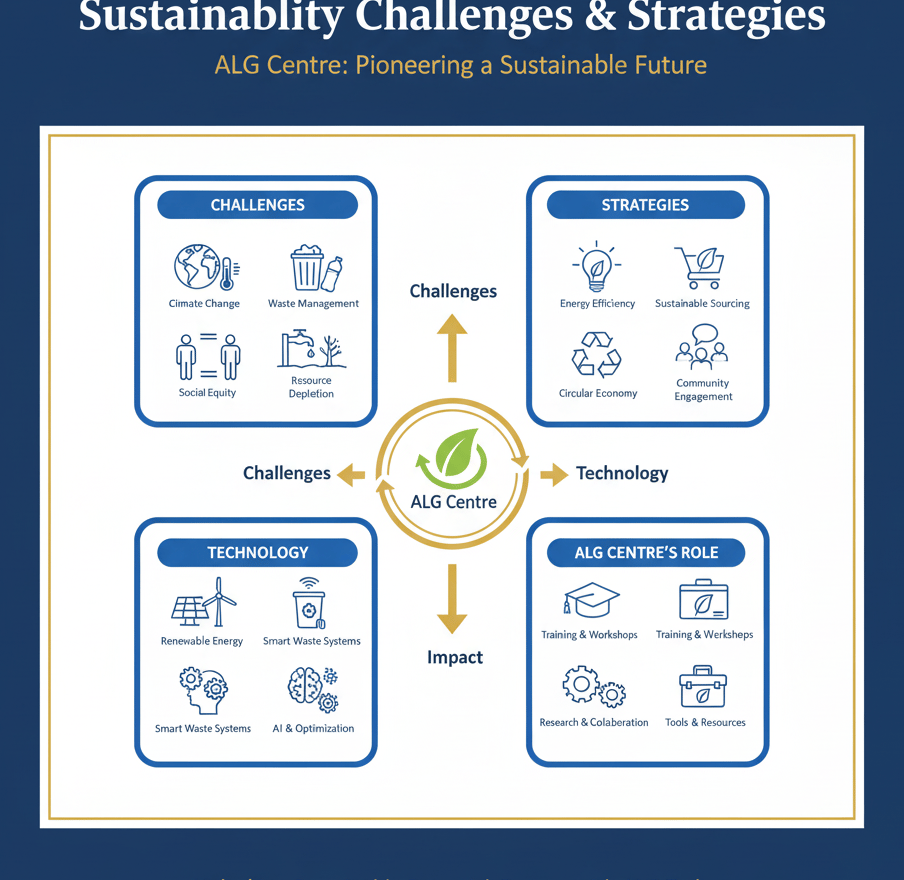
Sustainability challenges encompass a myriad of pressing issues that various industries and communities face today. One of the most prominent challenges is climate change, which has resulted in extreme weather patterns, rising sea levels, and biodiversity loss. These environmental shifts not only threaten ecosystems but also disrupt agricultural productivity, water supply, and human livelihoods globally. The urgency to address climate change cannot be overstated, as it is fundamentally linked to the survival of both natural and human systems.
Another critical challenge is waste management. With the continuous rise in population and consumption rates, various forms of waste, particularly plastic, accumulate at an alarming rate. Many communities struggle with inadequate waste disposal methods, leading to environmental pollution and health risks. Efficient waste management strategies are essential to mitigate these effects and support the transition towards a circular economy, where recycling and reuse minimize the extraction of raw materials.
Resource depletion presents additional sustainability challenges. Natural resources such as freshwater, fossil fuels, and minerals are being exploited at rates that exceed their regeneration capabilities. This unsustainable extraction threatens the availability of essential resources for future generations and exacerbates social inequalities, particularly in developing regions where access to these resources is often limited. The overconsumption of resources necessitates a rethinking of how industries operate and the ways in which society values and utilizes these resources.
Social equity is yet another dimension of sustainability challenges, as marginalized communities frequently bear the brunt of environmental degradation and resource scarcity. Addressing this imbalance is crucial for promoting inclusive and sustainable development. As the world grapples with these multifaceted sustainability challenges, it becomes increasingly vital to explore and implement strategies that can effectively counteract their adverse impacts and foster a more sustainable future for all.
Identifying Key Sustainability Issues
Sustainability is paramount in today's world, yet various challenges hinder its advancement. Among these, carbon emissions stand out as a significant contributor to climate change. The burning of fossil fuels for energy and transportation releases vast amounts of carbon dioxide and other greenhouse gases into the atmosphere. This increase in greenhouse gases accelerates global warming, which has far-reaching effects on weather patterns, sea levels, and ecosystems. Elevated temperatures impact agricultural productivity and threaten food security, heightening the urgency of this issue.
Another pressing challenge is pollution, particularly in urban areas where industrial activities release harmful substances into the air and water. Air pollution, resulting from vehicular emissions and industrial discharges, can have detrimental effects on human health, contributing to respiratory ailments and cardiovascular diseases. Water pollution, on the other hand, arises from agricultural runoff and untreated waste, leading to contamination of vital water sources and posing significant risks to aquatic ecosystems and human populations dependent on these resources.
Deforestation is yet another critical issue impacting sustainability. The clearing of forests for agriculture, logging, or urbanization results in habitat destruction and disrupts the intricate balance of local ecosystems. Trees play a vital role in carbon sequestration and help maintain biodiversity; therefore, their loss aggravates the impacts of climate change and contributes to the extinction of species. Additionally, the loss of biodiversity undermines ecosystem services essential for human survival, such as pollination and natural pest control.
These key sustainability issues—carbon emissions, pollution, deforestation, and loss of biodiversity—do not exist in isolation. They are interconnected, with each exacerbating the effects of the others. Understanding these relationships is crucial for developing effective strategies to promote sustainability and mitigate the profound implications for both human life and the health of the planet.
Overview of Sustainability Strategies
Sustainability is a multifaceted concept that requires organizations and individuals to adopt various strategies for effective implementation. One of the foremost areas where sustainability can be enhanced is energy efficiency. By adopting energy-efficient technologies and practices, such as LED lighting, smart meters, and energy recovery systems, organizations can significantly reduce their carbon footprint while simultaneously lowering operational costs. Moreover, regular energy audits can help identify areas for improvement, ensuring a continual commitment to efficiency.
Another critical strategy is sustainable sourcing, which involves selecting materials and products that are produced in an environmentally and socially responsible manner. Organizations can work closely with suppliers to ensure that raw materials are sourced ethically, factoring in the environmental impact of extraction processes and labor practices. Emphasizing local sourcing not only minimizes transportation emissions but also supports community economies by fostering local businesses.
The concept of circular economies presents compelling opportunities for organizations to rethink traditional production and consumption models. In a circular economy, waste is minimized, and resources are reused or recycled at the end of their lifecycle. This approach can be integrated through strategies such as designing products for durability, implementing take-back schemes, and promoting repairability. By pursuing a circular economy, organizations can contribute to waste reduction and resource conservation, significantly enhancing their sustainability profile.
Community engagement is another vital component of sustainability strategies. By involving local stakeholders, organizations can create initiatives that resonate with community needs while fostering a sense of shared responsibility. This may include educational campaigns about sustainability practices, partnerships with local organizations for environmental restoration, or initiatives aimed at improving community health through sustainable practices. By weaving sustainability into community engagement, organizations can cultivate a more supportive and informed public, further reinforcing their sustainability efforts.
The Role of Technology in Promoting Sustainability
Technology has emerged as a crucial ally in addressing sustainability challenges, offering innovative solutions that not only streamline operations but also significantly reduce environmental impact. Among the most promising developments is the advancement in renewable energy technologies, which play a pivotal role in transitioning from fossil fuels to cleaner energy sources. As countries strive to meet their carbon reduction targets, investments in solar, wind, and hydroelectric power have surged. These advancements not only enhance energy efficiency but also contribute to lowering greenhouse gas emissions, making a compelling case for technology as a sustainability driver.
Furthermore, smart waste management systems have gained traction in promoting sustainable urban living. These systems utilize sensors and data analytics to optimize waste collection and recycling processes. By monitoring waste levels in real-time, municipalities can reduce fuel consumption and increase recycling rates, thereby minimizing landfill use. The integration of technology in waste management leads to a more circular economy where materials are reused and repurposed, addressing the waste crisis that exacerbates environmental degradation.
Artificial intelligence (AI) emerges as another transformative force in resource optimization. AI applications can analyze data patterns to forecast demand, optimize supply chains, and predict maintenance needs for machinery. In agriculture, AI tools are being harnessed to increase crop yields while minimizing the use of water and fertilizers, thereby reducing the ecological footprint. By employing advanced algorithms, stakeholders can make informed decisions that promote sustainable practices across various sectors, effectively maximizing resource utilization and minimizing waste.
As we navigate the complex landscape of sustainability, harnessing technology offers a pathway to innovative solutions that drive progress, enhance operational efficiencies, and promote ecological balance. In leveraging these technologies, we are better equipped to tackle the pressing sustainability challenges of our time.
Introduction to the ALG Centre
The ALG Centre, dedicated to advancing sustainable development, presents a holistic approach to addressing environmental challenges. With a clearly defined mission focused on fostering collaboration among businesses, researchers, and policymakers, the centre aims to create effective and innovative solutions for sustainability. By integrating diverse perspectives and expertise, the ALG Centre facilitates knowledge sharing that is essential for tackling complex sustainability issues.
This institution is guided by a vision where sustainability is embedded in various sectors and practices, promoting both environmental integrity and economic growth. The ALG Centre is consistently striving to bridge the gap between theory and practice by offering programs that empower stakeholders to implement sustainable practices effectively. Through workshops, seminars, and research initiatives, the centre cultivates a deeper understanding of sustainability and its importance across different industries.
Moreover, the ALG Centre emphasizes the role of collaboration in achieving sustainable outcomes. By working closely with local businesses, governmental agencies, and academic institutions, the centre is instrumental in developing tailored sustainable strategies that align with specific community needs. This inclusive approach is evident in various programs, which often involve hands-on projects that reflect real-world challenges faced by organizations. The ALG Centre also acts as a resource hub, providing access to research, best practices, and tools necessary for implementing sustainable solutions.
In essence, the ALG Centre stands as a pivotal organization in the sustainability landscape, enriching the dialogue surrounding sustainable practices and fostering a cooperative environment that facilitates progress. Its commitment to sustainability is a guiding principle, supporting the development of practical strategies to navigate the challenges ahead.
How the ALG Centre Supports Sustainability Initiatives
The ALG Centre plays a pivotal role in promoting sustainability through a multifaceted approach tailored to the needs of various organizations. By offering specialized training programs, the Centre equips stakeholders with the necessary knowledge and skills to implement effective sustainability strategies. These programs cover crucial topics, such as sustainable resource management, carbon footprint reduction, and renewable energy practices, ensuring that participants are well-versed in contemporary sustainability issues.
Moreover, the ALG Centre organizes workshops that provide practical insights and hands-on experiences. These workshops facilitate knowledge sharing among participants, allowing them to learn from one another while addressing real-world sustainability challenges. Through these interactive sessions, attendees can collaborate on solutions, receive expert guidance, and develop actionable plans that can be implemented within their organizations.
Research collaboration is another key area where the ALG Centre significantly contributes to sustainability efforts. By partnering with academic institutions, government agencies, and private organizations, the Centre fosters research initiatives that investigate innovative sustainability solutions. This collaboration not only generates valuable insights but also promotes the dissemination of best practices that organizations can adopt to enhance their sustainability initiatives.
Additionally, the ALG Centre provides access to a wealth of tools and resources that empower organizations to advance their sustainability objectives. This includes comprehensive databases, assessment frameworks, and visual aids designed to simplify the evaluation of sustainability practices. By utilizing these resources, organizations can track their progress, identify areas for improvement, and benchmark their performance against industry standards.
In this way, the ALG Centre serves as an essential partner for organizations seeking to navigate the complex landscape of sustainability. Through training, workshops, research collaboration, and resources, the Centre supports stakeholders in addressing sustainability challenges effectively, fostering a more sustainable future for all.
Future Trends in Sustainability and the Role of ALG Centre
The landscape of sustainability is continuously evolving, with various trends emerging that address the pressing challenges of our time. One notable trend is the growing emphasis on social responsibility within organizations. Corporate social responsibility (CSR) is now viewed not merely as an ethical obligation but as a vital component of business strategy. Companies are increasingly held accountable for their social, economic, and environmental impacts. As such, organizations will need to prioritize not just profit margins but also their contributions to social equity and community investment.
Simultaneously, sustainable governance is gaining traction as an essential principle in driving long-term sustainability initiatives. This approach incorporates effective decision-making processes that balance stakeholder interests while aligning with environmental goals. Through transparent and inclusive governance practices, organizations can ensure that sustainability is woven into their very fabric, promoting resilience in an unpredictable future.
The ALG Centre is well-positioned to respond to these trends by adapting its programs and initiatives to foster innovation and collaboration among various stakeholders. Recognizing the need for a multidisciplinary approach, the centre plans to enhance partnerships with businesses, academia, and governmental organizations, focusing on creating shared value. By encouraging cross-sector collaboration, the ALG Centre aims to facilitate knowledge-sharing and best practices, driving impactful sustainability initiatives.
Moreover, the ALG Centre will actively invest in educational programs geared toward developing skill sets necessary for future sustainability leaders. These offerings will equip individuals and organizations to navigate the complexities of sustainable practices effectively, ensuring a capable workforce prepared to meet emerging challenges. The centre's commitment to promoting resilience and adaptability in sustainability practices will be crucial in shaping a sustainable future. This proactive approach underscores the importance of aligning sustainability with societal values, positioning the ALG Centre as a pivotal player in driving forward-thinking solutions.