
Strategic Project Management: Defining Vision, Mission, and SMART Goals
11/13/202512 min read
Understanding the Importance of Strategic Project Management
Strategic project management plays a crucial role in ensuring that projects are aligned with an organization's long-term vision and mission. By incorporating strategic thinking into project management, organizations can enhance their capabilities to meet goals and objectives. This alignment not only fosters greater efficiency but also promotes a unified approach to realizing an organization’s vision.
Defining Vision and Mission in Project Management
The vision of a project is a clear conceptualization of what success looks like at completion, often described in a compelling and forward-looking manner. It serves as the guiding star, helping project teams navigate challenges while maintaining focus on the end goal. Conversely, the mission encapsulates the purpose of the project, detailing why it exists and what it aims to achieve. Together, the vision and mission ensure that every aspect of project delivery is directed towards a common endpoint, thereby enhancing accountability and coherence.
Setting SMART Goals for Effective Project Execution
To operationalize the vision and mission, it is essential to establish SMART goals—Specific, Measurable, Achievable, Relevant, and Time-bound objectives. Specific goals provide clarity on expected outcomes, while measurable elements allow for progress tracking. Achievable goals ensure that project teams are set for success without unreasonable expectations, and relevant goals guarantee alignment with the overall organizational mission. Lastly, time-bound goals create a sense of urgency, driving teams to stay on schedule as they work towards achieving the project’s objectives.
By implementing a structured approach to defining vision, crafting mission statements, and setting SMART goals, organizations can significantly enhance their project management efficiency. The synergy created through this strategic alignment not only empowers teams but also facilitates the successful delivery of projects, regardless of size or complexity. Ultimately, strategic project management cultivates a culture of clarity, accountability, and proactive problem-solving, fostering an environment where innovative ideas can thrive and lead to successful outcomes.
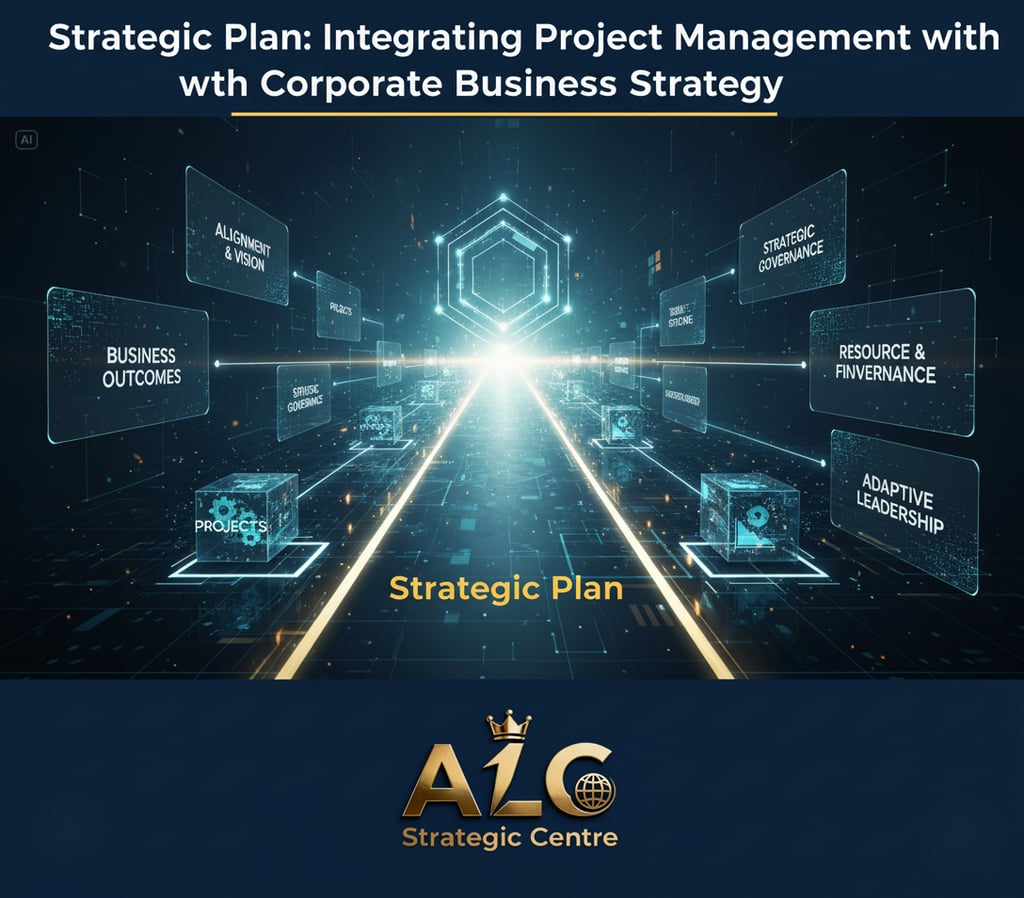
Strategic Plan: Integrating Project Management with Corporate Business Strategy
1.0 The Strategic Imperative of Project Alignment
1.1 Introduction: From Tactical Execution to Strategic Value Delivery
In an increasingly project-based business environment, the critical differentiator for success is no longer simply efficient execution, but the deliberate and systematic alignment of project work with overarching corporate objectives. As noted by Gartner and the National Bureau of Economic Research, organizations are becoming less hierarchical and more reliant on projects to gain a competitive edge. This shift has fundamentally altered the landscape of value delivery, moving project management from a purely tactical discipline to a core strategic function. A recent study underscores this evolution in executive priorities; the "State of the PMO 2012" found that for leaders in high-performing organizations, ensuring "alignment with business objectives" (cited by 75%) now significantly surpasses the traditional focus on "delivering projects on time" (61%). This strategic plan outlines a comprehensive framework for achieving this alignment, beginning with the foundational elements of corporate strategy that must guide every project initiative.
--------------------------------------------------------------------------------
2.0 The Strategic Foundation: A Hierarchy of Intent
2.1 Preamble: Defining the Strategic Compass
For any organization to succeed, it is essential that every individual, team, and project is "pulling in the same direction." This requires a clear and cascaded strategic framework that serves as a compass for all activities. A coherent hierarchy of intent—cascading from a long-term Vision to specific, immediate Action Plans—provides the clarity necessary to guide everyday activities, align stakeholders, and ensure that tactical execution drives progress toward the organization's ultimate purpose.
2.2 Defining the Strategic Hierarchy
The following multi-level list defines the core components that form an effective strategic hierarchy, ensuring a clear line of sight from high-level aspiration to ground-level execution.
Vision Statement
A future-oriented mental picture of what the organization wants to accomplish or achieve. It is the ultimate destination.
Example: A successful family dairy business.
Mission Statement
A present-oriented action statement explaining how the vision will be achieved. It is the guiding light for reaching the destination and typically begins with an action verb.
Example: To provide unique and high quality dairy products to local consumers.
Core Values
The principles and values that guide behavior and decision-making throughout the process of pursuing the mission and vision.
Strategies
The unique approaches and methods that detail how the mission will be used to achieve the vision. An organization may have several strategies.
Goals
General statements of what needs to be accomplished to implement a strategy. These are milestones in the process.
Example: Increase profit margin.
Objectives
Specific milestones for achieving a goal. To be effective, these must be translated from general statements into quantifiable, time-sensitive targets using a framework such as SMART (detailed in Section 5.0).
Action Plans
The specific implementation activities and tasks used to achieve an objective.
2.3 The Relationship Between Vision and Mission
A critical synergy must exist between the vision and mission. While the vision statement is a static picture of the desired future, the mission is the dynamic process for getting there. To be effective, both statements must be simple, concise, and easily remembered, targeting employee efforts in the same direction. When a vision and mission are misaligned or emphasize different domains, an organization risks becoming a "house divided against itself," leading to wasted effort and internal conflict. While this strategic foundation provides the high-level guidance, its value is only realized when connected to project execution through robust operational frameworks.
--------------------------------------------------------------------------------
3.0 Core Frameworks for Bridging Strategy and Execution
3.1 Preamble: Methodologies for Ensuring Alignment
A well-defined strategic foundation is only effective if it is supported by robust frameworks that translate intent into a tangible portfolio of value-delivering projects. This section evaluates two primary philosophies for achieving project alignment and introduces two powerful tools for visualizing and managing the crucial link between project activities and strategic benefits.
3.2 Contrasting Alignment Philosophies: Process-Driven vs. Position-Driven
Two major schools of thought inform how organizations can link projects to strategy. The choice between them depends on the organization's structure, environment, and the nature of the projects being undertaken.
Process-Driven Alignment
Position-Driven Alignment
This is a traditional, linear approach consistent with the "design school" of strategic thought. Strategy is formulated at the executive level and then cascaded down through the organization into programs and projects.
This is a more dynamic and emergent approach aligned with the "learning school" of thought. A project's strategy is actively positioned based on its unique context, resources, and competitive environment.
Models from authors like Turner (1999) and Cleland (1998) exemplify this view, where projects are seen as the end result of a formal business planning process, designed to fulfill a pre-defined business need.
This philosophy views the project as an actor that must scan its environment, manage its resources, and position itself to succeed. It is particularly suitable for innovation projects operating under conditions of uncertainty.
3.3 Visualizing the Strategy-to-Benefit Chain
To make the connection between strategy and projects explicit, two primary visualization tools are commonly used.
The Balanced Scorecard (BSC) and Strategy Maps
The Balanced Scorecard is a performance management system that translates vision and strategy into implementable initiatives across four key perspectives:
Financial
Customer
Internal Business Processes
Learning & Growth
Strategy Maps are the visual component of the BSC. They are diagrams that graphically connect objectives and initiatives across these four perspectives to illustrate how an organization intends to create value. For example, a simplified Strategy Map for a telecommunications company might show how investing in a "New Mobile Product" (Learning & Growth) enables a "New eCommerce Sales Channel" (Internal), which drives "Market-share Growth" (Customer) and ultimately contributes to "Increased Sales" (Financial).
The Benefits Model
Derived from the Managing Successful Programmes (MSP) method, the Benefits Model is a powerful, benefits-focused tool that provides a step-wise refinement from high-level objectives down to the specific projects that enable them. It maps the causal chain that delivers value, flowing from project activities (Enablers) on the right to high-level strategic goals (Objectives) on the left:
Objective ← Outcome Benefit ← Output Benefit ← Changed/New Capability ← Enablers (Projects)
By detailing this sequence, the Benefits Model makes the entire implementation path visible, testable, and measurable. Each link in the chain can be scrutinized and validated, increasing stakeholder confidence. While Strategy Maps offer a high-level summary, Benefits Models provide a richer, more useful decision support and monitoring tool. They ensure strategic alignment "by design" by forcing planners to articulate precisely how a project's deliverables will translate into the tangible business outcomes that leadership values. This benefits-driven logic is powerful, but for complex innovation initiatives, it must be paired with a governance model that matches a project's autonomy to its strategic context.
--------------------------------------------------------------------------------
4.0 A Proposed Model for Strategic Project Positioning in Innovation
4.1 Preamble: A Dynamic Model for Innovation Projects
Traditional, top-down strategic alignment models often fail when applied to innovation projects because they do not account for the inherent uncertainty and risk. These initiatives are characterized by high degrees of complexity, where the path to success is emergent rather than pre-defined. For such projects, a nuanced, position-driven approach is required—one that manages risk by aligning project strategy with its unique context and relationship with its stakeholders, rather than a rigid corporate mandate.
4.2 The Position-Driven Framework
A framework developed by Artto et al. (2007) offers a powerful lens for positioning innovation projects. It classifies projects based on two determining variables, yielding four distinct strategic positions.
Project Autonomy: The degree of independence and decision-making authority a project has from its parent organization.
Stakeholder Complexity: The number of strong, influential stakeholder organizations involved in the project.
These variables create a 2x2 matrix that defines four primary project strategies:
One Strong Stakeholder
Several Strong Stakeholders
Low Project Independence
Obedient Servant: The project's primary function is to align with and execute the strategy of a single parent organization.
Flexible Mediator: The project must negotiate and compromise to develop a strategy that balances the interests of many powerful stakeholders.
High Project Independence
Independent Innovator: The project operates with significant autonomy, focusing on radical renewal that may challenge or redefine the parent's existing strategy.
Strong Leader: The project is highly autonomous and operates in a complex environment, creating and surviving by building a new community, industry, or ecosystem.
4.3 Strategic Implications and the Evolution of Project Autonomy
The AIG Europe IT Platform case study provides a compelling real-world example of how a project's strategic position can evolve. The project began its rollout with more autonomy in the Milan office, a high-potential market where the parent company's knowledge was low. In this context, the project operated closer to an 'Independent Innovator,' with local input being crucial for success. However, as the parent's learning curve increased and the platform was rolled out to the Stockholm office—a market perceived as having lower strategic importance—the project's role shifted. It became an 'Obedient Servant,' with a top-down mandate and little room for local adaptation.
This case study yields several key strategic insights:
The Evolving Parent Perspective: A parent organization's view of a project is not static. As a project progresses and the parent gains knowledge, it may alter the level of autonomy granted to the project team, effectively changing the project's strategic position.
The Risk of Total Obedience: Forcing an innovation project into a purely 'Obedient Servant' role is risky. It can stifle crucial feedback from end-users and other implicit stakeholders (such as customers or brokers), which may jeopardize the ultimate success of the parent's strategy by failing to adapt to market realities.
The Influence of Perceived Importance: The parent strategy dictates project autonomy based on the perceived strategic value of a project's context. In the AIG case, the Milan office was seen as having higher growth potential and was thus granted more autonomy to ensure success, while the Stockholm office received a standardized solution.
While this position-driven model provides the essential macro-level governance for innovation, its success is contingent on translating this strategic positioning into unambiguous, tactical execution at the project level.
--------------------------------------------------------------------------------
5.0 Executing with Precision: The Role of SMART Goal Setting
5.1 Preamble: Translating Strategy into Actionable Objectives
High-level strategic intent, however well-defined, remains an abstraction until it is translated into clear, tangible, and measurable objectives for the teams responsible for execution. The SMART goals framework is the definitive methodology for achieving this translation, converting broad ambitions into a focused roadmap that guides daily work and provides a clear definition of success.
5.2 The SMART Goal Framework
The framework requires that every objective meets five distinct criteria, ensuring clarity, focus, and accountability.
S - Specific
Definition: The goal must be clear and well-defined, answering the "who, what, where, when, and why."
Why It Matters: Specificity eliminates ambiguity and provides a focused direction. It prevents misaligned efforts and ensures resources are allocated to drive intended results.
M - Measurable
Definition: The goal must include quantifiable indicators to track progress and determine when it has been achieved.
Why It Matters: Measurability transforms a wish into a manageable target. It enables objective performance tracking, data-driven course correction, and a clear definition of "done."
A - Achievable
Definition: The goal must be realistic and attainable given the available resources, skills, and constraints.
Why It Matters: Setting unrealistic goals demotivates teams and erodes momentum. Achievable goals challenge teams to stretch while maintaining morale and focus on delivery.
R - Relevant
Definition: The goal must align with broader business objectives and contribute meaningfully to the organization's strategic direction.
Why It Matters: Relevance ensures that project efforts create strategic value. It maintains focus on critical priorities and prevents resources from being wasted on activities that do not advance the mission.
T - Time-Bound
Definition: The goal must have a clear deadline or timeframe for completion.
Why It Matters: Deadlines create a sense of urgency, enable effective prioritization, and provide a clear timeline for tracking progress against commitments.
5.3 Application Example: From Vague Intent to SMART Goal
The power of the SMART framework is best illustrated through an example. Consider the common but vague goal, "I want to complete a project." By applying the SMART criteria, this intent is transformed into an actionable and robust objective.
Initial Goal: I want to complete a project.
Applying the SMART Framework:
Specific: Launch a mobile app for our company website to improve the poor customer experience on mobile devices. This will require involvement from software development, design, and marketing.
Measurable: Achieve 50,000 installs of the app within six months of launch and show a 5% conversion rate from customers using it.
Achievable: The involved departments have signed off on creating the app. The project will be managed with clear milestones to keep everyone on target.
Relevant: Improving the customer experience on mobile devices is a core company initiative this year.
Time-Bound: The app must be launched by the end of Q2 to achieve the install and conversion targets by the end of the fiscal year.
Final SMART Goal: "To address a core company initiative of improving the mobile customer experience, we will launch a new mobile app by the end of Q2. The project's success will be measured by achieving 50,000 installs and a 5% conversion rate by the end of the fiscal year, supported by a marketing campaign running through year-end."
Ultimately, the effectiveness of these tools and processes depends entirely on the strategic capability of the people leading these efforts.
--------------------------------------------------------------------------------
6.0 The Business-Savvy Project Manager: A New Breed of Leader
6.1 Preamble: The Human Element in Strategic Execution
Even the most sophisticated frameworks and meticulous plans will fail without the right leadership at the helm. Strategic alignment is not an automated process; it is driven by people. This requires a critical evolution from the traditional, technically-focused project manager to a new breed of leader: the "Business-Savvy Project Manager," who acts as a bridge between tactical execution and strategic intent.
6.2 Shifting the Project Management Mindset
The transition to a strategically aligned organization requires a fundamental shift in how project managers view their role and measure success.
Focus of Traditional PMs
Focus of Business-Savvy PMs
Tactical
Strategically driven
Management of a single project
Integration, coordination, and control of prioritized projects
Project-wide, not necessarily cross-functional
Organization-wide and cross-functional
A specialist function
A business philosophy integrated with project management
A discipline
An operating environment
6.3 Core Competencies and Responsibilities
The business-savvy project manager's responsibilities extend far beyond the triple constraint of scope, schedule, and cost. They must cultivate a new set of competencies focused on delivering business value.
Translate Project Metrics to Business Language A core responsibility is to shift communication away from project-centric jargon and toward the language of business impact. This requires a foundational understanding of financial metrics and business case construction. This means translating metrics as follows:
Cost becomes Financial Impact.
Schedule becomes Time to Market.
Scope becomes Parameters for Success.
Act as a Strategic Consultant This leader reinforces the strategic reasons for the project's existence and understands its business value, whether through cost reduction, business growth, or maintaining operations. This requires being "intelligently disobedient" when tactical execution threatens strategic outcomes and demonstrating a clear understanding of how the project impacts the customer and the overall organization.
Engage and Communicate with the C-Suite To gain and maintain executive support, communication must be framed around business results and outcomes. Executives have limited time and focus on value, not process. The most successful project managers are those who can clearly articulate how their project's progress and results impact the bottom line and advance corporate strategy.
Build the Business Case The business-savvy project manager must be able to think through and articulate how their project aligns with organizational goals. Using a business case—formally or informally—to map out quantified benefits, risks, and the overall value proposition places the project firmly in the business world and moves the conversation beyond purely technical concerns.
This evolution in leadership provides the final, crucial link needed to create a truly strategy-driven organization ready for the final set of strategic actions.
--------------------------------------------------------------------------------
7.0 Conclusion and Strategic Recommendations
7.1 Summary of the Strategic Approach
Achieving sustained competitive advantage in a project-driven economy requires more than excellence in execution; it demands a dynamic, benefits-focused integration of project management and business strategy. This is accomplished through a clear hierarchy of strategic intent, the use of frameworks like Benefits Models that make the value chain explicit, and a nuanced, position-driven approach to governing high-stakes innovation projects. Ultimately, this entire system is powered by a new generation of business-savvy project leaders who speak the language of value and bridge the gap between corporate vision and project delivery.
7.2 Actionable Recommendations for Senior Management
To embed these principles into the organization's operating model, senior management should prioritize the following initiatives:
Adopt a Position-Driven Portfolio Approach: Formally adopt the position-driven framework to classify key innovation projects based on their autonomy and stakeholder complexity. This will enable tailored governance strategies, such as granting higher autonomy and resources to projects with significant strategic potential operating under high uncertainty.
Mandate the Use of Benefits Models: Instruct the enterprise PMO to replace or supplement existing planning tools with Benefits Models. This will enforce a clear, traceable, and measurable link from every project investment to a specific, strategic business outcome, ensuring that all projects are aligned "by design."
Develop Business-Savvy Project Leadership: Create a targeted leadership development program focused on the core competencies outlined in Section 6.0. This program should train project managers in strategic communication, business case development, financial literacy, and executive-level stakeholder engagement to cultivate the next generation of business-focused leaders.
Establish a Dynamic Strategy Review Process: Implement a regular, formal review process where feedback and learnings from projects—especially from high-autonomy innovation projects—are used to challenge and refine high-level corporate strategy. This creates a true feedback loop, ensuring that strategy is not only cascaded down but is also informed by the realities of execution and the market.